

Log InOpen Account
Trading

Crypto Trading at Abra: Execution built for scale

Abra develops crypto trading technology that seeks to support professional investors by reducing fees and spreads and enables access to leverage.

Contact Abra
At a glance

Crypto trading at Abra supports spot trades and over-the-counter execution through Abra Capital Management.

Abstract render of a precision-machined metal trading device
Crypto Trading Technology

Built for Professional Investors

Abra develops digital asset trading technologies that provide the simplicity of spot trades with an execution layer that works at scale. Whether you are rebalancing a portfolio, adding leverage, or executing a large block trade, ACM can arrange trade execution for you or your organization, backed with detailed reporting.

Abra Capital Management · Spot trading

How a spot trade moves through your Vault

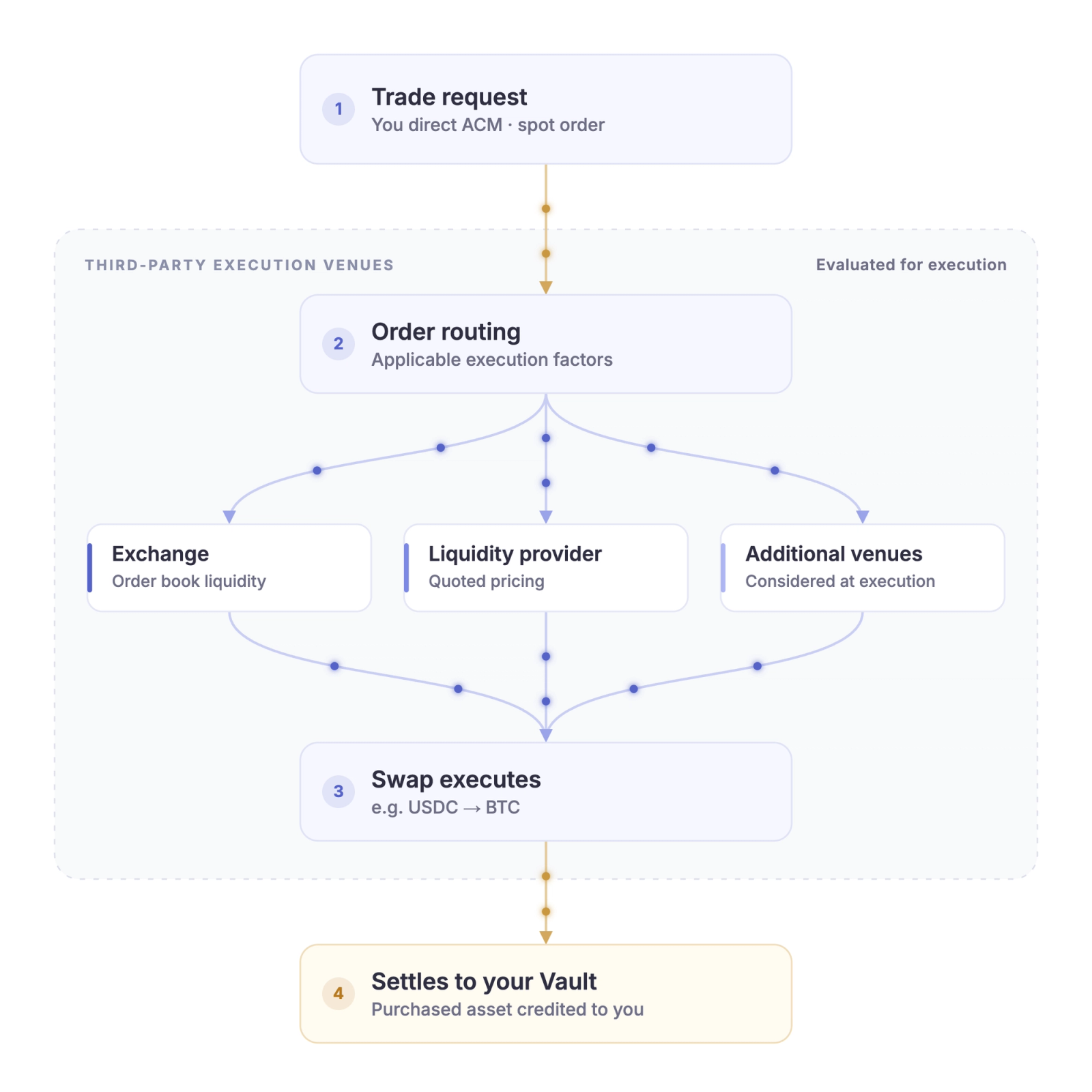
Eligible supported assets in your Vault may be available for spot trading. When you place an authorized spot trade, ACM arranges execution through applicable third-party venues, seeking favorable execution terms, and the purchased asset generally settles to your Vault.

Diagram of a spot trade: you direct ACM with a trade request, the order is routed across third-party execution venues (an exchange, a liquidity provider and additional venues) based on applicable execution factors, the swap executes, for example USDC to BTC, and the purchased asset settles to your Vault.

How does crypto trading work at Abra?

Spot and over-the-counter execution for US regulated clients runs through Abra Capital Management, LP, an SEC-registered investment adviser.

Spot and OTC are Abra Capital Management products, described in regulatory terms on the Abra Capital Management trading pages rather than here.

Institutional crypto trading, such as a family office rebalancing a digital asset sleeve or a corporate treasurer moving between cash, stablecoins and Bitcoin under a board policy, typically runs through the regulated desk.


Spot and OTC trading through Abra Capital Management

What is the difference between spot and OTC trading?

Whether it is Bitcoin trading or a stablecoin conversion, spot and OTC execution answer different needs: price certainty, size and convenience.

A spot trade exchanges one asset for another at the price available now. An OTC trade gives a firm quote for an institutional-size block, so a large order does not move the visible market. Both change what you own.

Who is the Abra trading desk for?

If you are a US regulated client, such as an RIA, a family office, a corporate treasury or an individual with an advisory account, and you want execution inside an account with regulatory structure and reporting, the Abra Capital Management desk is the route. It handles spot trades and OTC blocks.

What are the risks of crypto trading?

Digital assets are volatile, and every trading route carries the risk of loss, including loss of principal. Execution quality, fill prices and settlement times are not guaranteed, and market conditions affect fills.

Counterparty and settlement risk sit with every route. Until a trade settles you depend on the venue or desk to deliver, and afterwards on whoever holds the asset. Onchain venues add smart contract risk. Before you trade, know which entity you are dealing with, where your assets will sit and which terms govern the trade.

Abra Perps
Abra Perps · Coming soon

Your collateral should never sit still.

A perpetual trading venue where your yield bearing AbraFi assets post directly as margin. Take the position you want. Keep the yield you already earn.

Risk. Abra Perps will not be available in the United States or to US persons. Positions are leveraged and can be liquidated; with cross-margin, a loss on one position can take collateral from the others.

Disclaimer

Understand the risk

This page is general information about crypto trading routes at Abra. It is not an offer or a solicitation and is not investment, legal or tax advice. Digital assets are volatile and involve risk of loss, including loss of principal. Execution quality, fill prices and settlement times are not guaranteed. Availability varies by jurisdiction. Abra Capital Management, LP is an SEC-registered investment adviser. Registration does not imply a certain level of skill or training.

FAQ

Questions, answered.

Yes, for regulated clients. Over-the-counter execution runs through Abra Capital Management, LP, an SEC-registered investment adviser. The desk gives a firm quote for an institutional-size block, sourced from several liquidity providers, so a large order does not move the visible market. Terms, eligibility and pricing are set out on the Abra Capital Management trading pages.

Through Abra Capital Management, the trading desk covers Bitcoin, Ethereum, Solana and major US dollar stablecoins as standard, with other assets quoted on request subject to liquidity, custody support and compliance approval.

A spot trade exchanges one asset for another at the current market price, such as US dollars for Bitcoin or Bitcoin for a stablecoin. Ownership changes once the trade settles, and there is no contract to roll over or expiry date. A spot trade changes what you hold, so you take on the full price exposure of the asset you buy.

The two terms describe different things. "Spot" is the type of transaction: an exchange of assets at the current price. "Over-the-counter" (OTC) describes how a trade is arranged: privately, through a quote from a counterparty, instead of on a public order book. An OTC trade can itself be a spot trade. OTC arrangements are typically used for larger orders. Through Abra Capital Management, LP ("ACM"), OTC execution is available through third parties.

Three things matter: the market price, the spread and fees. The spread is the gap between the price buyers will pay and the price sellers will accept. On the Abra platform it is the spread of the applicable trading venue or counterparty. Fees are set out in the applicable agreement. A quoted or displayed price is indicative until an order executes, and the final price can differ.

Slippage is the difference between the price you expected and the price your order actually fills at. It happens when prices move between placing an order and its execution, or when an order is large relative to what is available at the quoted price. Slippage is usually larger in fast-moving or thinly traded markets.

A market order buys or sells at the best price available when it executes, which favors speed over price certainty. A limit order sets the worst price you will accept and fills only at that price or better, which favors price over certainty of execution. A limit order may fill only partly, or not at all.

ACM may direct purchases and sales of digital assets in implementing a client's investment strategy. Execution is effected through applicable trading venues, counterparties and service providers, and different venues may be used for different trades. Eligibility, minimums and fees are set out in the investment management agreement.

Settlement is the point where both sides of a trade are delivered. Until then you depend on the venue or counterparty to complete it, and a failure, delay or operational problem can affect whether and when the trade settles. Settlement timing is not guaranteed, and it can vary by asset, network and venue.

No. A stablecoin is a digital token designed to track the US dollar. It is not a bank deposit, is not FDIC- or SIPC-insured, and can trade below one dollar if confidence in its issuer or its reserves weakens. Converting between a stablecoin and dollars is a trade like any other, with its own spread, fees and settlement risk.

In the United States, exchanging one digital asset for another, or for dollars, is generally treated as a disposition that may create a taxable gain or loss. That includes trades into stablecoins. Treatment depends on individual circumstances and jurisdiction, and guidance can change. Keep records of each trade and consult a qualified tax adviser.

Tell Abra how you trade

Tell Abra the asset, the approximate size, your timing and whether you are a regulated client. Abra will tell you how the trade is executed and priced before anything moves.

Contact Abra